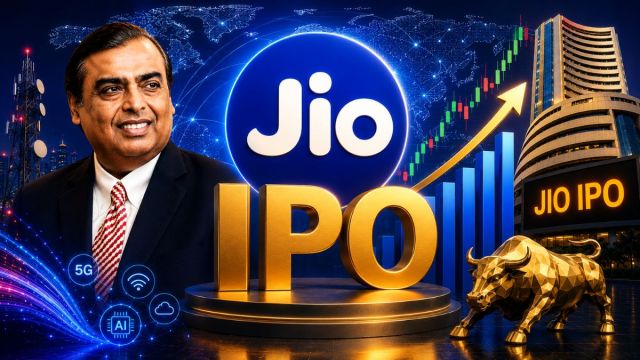
The blueprint of India’s digital macro-economy underwent a massive structural shift on Friday, June 19, 2026. In a sweeping corporate announcement that immediately reverberated across global financial…
The blueprint of India’s digital macro-economy underwent a massive structural shift on Friday, June 19, 2026. In a sweeping corporate announcement that immediately reverberated across global financial hubs, Reliance Industries Limited (RIL) confirmed that the board of Jio Platforms Limited (JPL) has officially submitted its Draft Red Herring Prospectus (DRHP) to the capital markets regulator, SEBI.
This is not merely another large-cap public listing—it is structurally engineered to become the single largest initial public offering in the history of Indian equity markets. According to cross-border investment banking syndicates managing the book-building process, the primary market issue targets an unprecedented capital raise of $4.5 billion (approximately ₹37,700 crore).
This historic figure completely shatters the previous primary market benchmark of ₹27,870 crore set by Hyundai Motor India in 2024. For the Mukesh Ambani-led Reliance conglomerate, this marks the first time in exactly twenty years that a core subsidiary is hitting the public exchanges, drawing a straight line back to the legendary Reliance Petroleum IPO in 2006.
For institutional fund managers, asset allocators, and research desks requiring a hyper-detailed, data-backed Jio Platforms IPO DRHP analysis, this exhaustive corporate dossier dismantles the financial balance sheets, structural parameters, valuation multiples, and operational matrices behind this generational public market event.
1. Core Issue Parameters & The 2.5% Mega-Float Framework
The data embedded in the newly submitted 500+ page draft prospectus paints the picture of a highly disciplined, growth-focused capital drive.
A critical takeaway for prospective shareholders is that this mega-IPO is structured entirely as a 100% Fresh Issue. Management has bypassed an Offer for Sale (OFS) component entirely.
While internal deliberations in early 2026 weighed a hybrid structure that would allow early financial backers to liquidate a portion of their stakes, the final board-approved filing establishes that zero legacy equity is being sold. This means global technology giants and sovereign wealth funds are holding their positions tight. No existing shareholder is draining capital out of the system. Every individual rupee raised through the electronic book-building process will bypass existing investors and land squarely inside the company's operational treasury to finance future expansion.
+-----------------------------------------------------------------------+
|                    JIO PLATFORMS IPO CORE METRICS                     |
+------------------------------------+----------------------------------+
| Total Share Volume                 | Up to 27,00,00,000 Equity Shares |
| Share Structure                    | 100% Fresh Issue (Zero OFS)      |
| Dilution Ratio                     | ~2.9% of Post-Issue Paid-Up Base |
| Face Value Baseline                | ₹10 Per Individual Equity Share  |
| Target Capital Raise               | ~$4.5 Billion (~₹37,700 Crore)   |
| Listing Trading Boards             | Dual Listing on NSE and BSE      |
+------------------------------------+----------------------------------+
This massive scale was facilitated by an aggressive regulatory amendment by SEBI and the Ministry of Finance for ultra-large corporations. Previously, massive companies hitting the market were mandated to dilute at least 5% of their equity base upfront and scale to 25% within three years—a rule that threatened to flood the market with excess paper and depress stock prices. Under the revised framework for ultra-large entities (with a post-issue market cap exceeding ₹5 lakh crore), the initial public float requirement has been lowered to just 2.5% to 2.9%. More importantly, the lock-in timeline to reach the mandatory 25% public shareholding threshold has been extended to a comfortable 10 years, allowing a controlled, phased equity dilution over a decade.
2. Financial Forensics: Auditing the Multi-Trillion Gross Profit Engine
Jio Platforms is approaching the public exchanges from a position of undisputed fiscal and operational dominance. The audited financial summary filed for the fiscal year ended March 31, 2026, details unprecedented profitability scaling and massive network operating leverage within the digital services segment.
Consolidated Financial Summary (FY25 vs. FY26)
Financial Accounting ParameterFY25 (Ended March)FY26 (Ended March)Year-on-Year Growth (%)Gross Revenue from Operations₹1,28,218 Crore₹1,46,885 Crore+14.6%EBITDA₹64,170 Crore₹76,255 Crore+18.8%EBITDA Margin (%)50.10%51.91%+181 bpsProfit Before Tax (PBT)₹35,127 Crore₹40,353 Crore+14.9%Net Profit After Tax (PAT)₹26,109 Crore₹30,049 Crore+15.1%Diluted Earnings Per Share (EPS)-₹33.59-
Operational Scale Indicators: Dismantling the Subscriber Moat
The compounding nature of Jio's top-line and bottom-line expansion is directly anchored to world-class operational metrics:
- The Subscriber Moat: Jio’s total active subscriber base scaled past 524.4 million users, cementing its status as the absolute market leader in India and the second-largest single-country mobile operator on the planet, trailing only China Mobile.
- The 5G Migration: Out of its half-billion user base, 268.5 million subscribers have successfully migrated to Jio's standalone 5G network, representing the largest single-country 5G subscriber pool outside of mainland China.
- The ARPU Trajectory: Driven by strategic multi-tier tariff hikes executed across late 2024 and 2025, alongside premium data add-on consumption from 5G upgrades, Jio's Average Revenue Per User (ARPU) climbed to a healthy ₹214 per month.
- Data Consumption Explosion: In the fourth quarter of FY26, monthly data consumption per customer stood at an incredible 42.3 GB. During FY26, Jio’s future-ready network single-handedly carried nearly 60% of India's total wireless data traffic.
- Fixed Broadband Dominance: Beyond mobile, Jio’s fixed broadband wing reached 27.1 million home connections by March 31, 2026, commanding a staggering 67.56% share of all net broadband additions in the country during the fiscal year.
3. Balance Sheet Deleveraging: The $3.3 Billion Cash Purge
Understanding where the IPO cash will be deployed reveals why management is rushing to hit the public exchanges. The fresh capital injection has a single, hyper-targeted strategic objective: Complete Deleveraging.
According to the DRHP text, an aggregate amount of up to ₹27,500 crore ($3.3 billion) of the net IPO proceeds will be explicitly utilized for the prepayment or full/partial repayment of the principal amount outstanding on certain borrowings. These debts are held by its core material operating subsidiary, Reliance Jio Infocomm Limited (RJIL).
+-----------------------------------------------------------------------+
|                 RJIL NET DEBT DESTRUCTION TRAJECTORY                  |
+-----------------------------------------------------------------------+
| March 2024 (Audited Debt)       |  ₹48,440.00 Failed                  |
| March 2025 (Audited Debt)       |  ₹45,273.40 Crore                   |
| March 2026 (Audited Debt)       |  ₹27,579.20 Crore                   |
| Post-IPO Target Debt            | ~₹    79.20 Crore (Virtually Zero)  |
+-----------------------------------------------------------------------+
As of March 31, 2026, Jio Platforms and its subsidiaries carried a combined borrowing load of ₹71,529 crore, but the core telecom operational debt at RJIL had already been aggressively managed down to ₹27,579.20 crore.
By routing ₹27,500 crore of public equity directly into debt eradication, Jio Platforms is transforming its capital-intensive telecom arm into a virtually debt-free enterprise. This move will immediately eliminate massive annual interest obligations starting in FY27. It completely neutralizes the company's interest rate risk and frees up astronomical amounts of free cash flow to bankroll their next technological push, including AI infrastructure and cloud expansion.
4. Valuation Modeling: Global Tech Platform vs. Conventional Telco
Because this public offering seeks to dilute a tight float of roughly 2.9% to collect up to ₹37,700 crore, it implies a truly monumental enterprise valuation that is sparking intense debate among institutional analysts.
The Tech Platform Valuation Model ($130B – $180B)
The 19 book-running lead managers (BRLMs) managing the book-building process are pitching Jio not as a legacy wireless utility, but as a full-stack digital platform ecosystem. They point out that Jio's foundational connectivity layer supports deep enterprise software infrastructure, cloud gaming, IoT solutions, digital commerce, cybersecurity, and an expanding network of sovereign AI data centers. Furthermore, their proprietary Unlicensed Unicast Broadband (UBR) technology allows rapid, low-disruption deployment of JioAirFiber, which is currently adding up to 60,000 links daily. Under this global tech multi-tier premium model, Jio Platforms is being valued between ₹11.2 lakh crore and ₹15 lakh crore ($135B – $180B).
The Relative Valuation Model (The Airtel Benchmark)
To evaluate the issue on a fundamental basis, institutional desks are running relative valuation models against listed peer Bharti Airtel, which currently sits at a market capitalization of roughly ₹11.6 lakh crore.
As disclosed in the DRHP, Jio Platforms reported a diluted Earnings Per Share (EPS) of ₹33.59 for the fiscal year ended March 2026. Bharti Airtel currently trades at a Price-to-Earnings (P/E) multiple of roughly 42.2x. Applying that exact sector leader P/E multiple to Jio’s EPS yields an implied fair value valuation of approximately ₹12.69 lakh crore (~$152 billion). This positions Jio Platforms comfortably ahead of Airtel as India’s most valuable telecom and digital platform, ranking it among the top three largest listed entities in corporate India.
5. Pre-IPO Cap Table: Mapping the Alliances
The pre-issue cap table of Jio Platforms remains heavily locked inside institutional vaults. Promoters Reliance Industries Limited retain absolute corporate control with a commanding 66.43% stake.
The remaining ~33.57% block reflects the historic 2020 fundraising super-cycle wherein Jio raised over $20 billion from the world's most sophisticated tech and private equity giants. Because this is a 100% fresh issue, these early-stage investors are staring at a massive 3x to 4x appreciation on their initial capital without diluting a single share.
+-----------------------------------------------------------------------+
|                        PRE-IPO SHAREHOLDING MATRIX                    |
+------------------------------------+----------------------------------+
| Reliance Industries Limited (RIL)  | 66.43% (Absolute Controller)     |
| Meta Platforms (Jaadhu Holdings)   |  9.98% (Premium Tech Anchor)     |
| Google International               |  7.73% (Strategic Ecosystem)     |
| PE Blocks (KKR, Silver Lake, Vista)|  7.51% (Financial Consortium)    |
| Sovereign Wealth Funds (PIF, ADIA) |  8.35% (Global Patient Capital)  |
+------------------------------------+----------------------------------+
6. Deep Dive: The Core Drivers of Jio's Long-Term Tech Expansion
To justify a global tech-platform multiple over a standard telecom multiple, the DRHP highlights an intense capital investment phase focused on three key corporate growth vectors. These metrics show that Jio is evolving past standard mobile subscriptions:
Vector A: Sovereign AI Infrastructure and Cloud Monopolization
Jio is actively constructing massive, AI-native data centers across multiple domestic hubs. Operating in deep partnership with global chip designers, Jio's target is to offer localized, low-latency AI compute pipelines to Indian developers, enterprises, and startups. This sovereign cloud layer will utilize Jio’s massive national fiber backhaul network, ensuring that data transmission costs remain structurally lower than international hyper-scaler options.
Vector B: Enterprise Software and IoT Deployments
The enterprise data section of the DRHP reveals that Jio's business-to-business (B2B) ecosystem is expanding. The company is actively deploying end-to-end cloud telephony, managed cybersecurity packages, automated billing systems, and Internet of Things (IoT) sensors to millions of micro, small, and medium enterprises (MSMEs). This creates highly predictable, high-margin software-as-a-service (SaaS) revenue lines that completely bypass standard telecom subscriber metrics.
Vector C: Fixed Broadband Penetration (JioAirFiber)
A significant operational driver moving into late 2026 is the rollout of JioAirFiber. Leveraging their 5G network core, Jio is targeting the connectivity of over 100 million households. By bypassing the physical, expensive labor of laying copper or fiber cables to single homes, their fixed-wireless access (FWA) technology allows Jio to add up to 60,000 new household links per day. Home broadband users traditionally register 3x higher data consumption and double the retention rates compared to standard wireless mobile clients.
7. The Launch Sequence & Procedural Timeline
Now that the DRHP has been officially logged with the capital markets regulator, the procedural countdown has formally begun. Market participants must track the timeline through four highly distinct clearing phases:
- Phase 1: The Regulatory Audit (Next 60–90 Days): SEBI’s review desk will thoroughly cross-verify the draft prospectus. The regulator will check accounting treatment definitions, corporate disclosures, and fund-utilization parameters before issuing its formal "Observations" and clearing notes.
- Phase 2: Final RHP Lodgement and Price Band Declaration: Once SEBI issues its formal approval, Jio Platforms will file its updated Red Herring Prospectus (RHP) with the Registrar of Companies (RoC). This filing will officially unveil the exact Price Band (the floor price and cap price per share), the precise Lot Size, and the exact operational dates for the bidding window.
- Phase 3: The Anchor Bidding Day: Exactly one business day prior to the general public launch, the Anchor Investor portion will open. Global mutual funds, insurance companies, and sovereign wealth desks will bid for up to 50% of the institutional quota, setting the initial institutional benchmark for the issue.
- Phase 4: The 3-Day Public Bidding Block: The issue will open to the general public under strict book-building protocols. Retail individual investors (allocated at least 35% of the net issue) and Non-Institutional Investors/HNIs (allocated at least 15%) will get a strict, regulatory-mandated 3 working days to submit their ASBA applications via their trading portals. Merchant banking circles project the final trading debut on the NSE and BSE to take place toward late Q3 or early Q4 of 2026 (likely around September or October).
Post Excerpt
An exhaustive statistical, structural, and operational analysis of the historic Jio Platforms IPO DRHP filed with SEBI. We dissect the ₹37,700 crore issue structure, evaluate the 100% fresh issue format, analyze the ₹30,049 crore FY26 net profit margins, trace the ₹27,500 crore balance sheet deleveraging plan, explore deep AI expansion models, and outline the upcoming mainboard launch timeline.